
The Complex Shoulder | Practical Course
Master the advanced assessment and rehabilitation of complex shoulder presentations using a structured clinical reasoning framework through blended online learning and immersive practical training.
Some patients don't respond to conventional rehabilitation because multiple biological, neurological and psychosocial factors interact to drive persistent pain and movement dysfunction. This course provides a structured clinical reasoning framework, advanced clinical assessment and rehabilitation skills to help you confidently assess and manage these challenging patients.
You'll be guided by a practical roadmap for assessing complexity and prioritising rehabilitation.
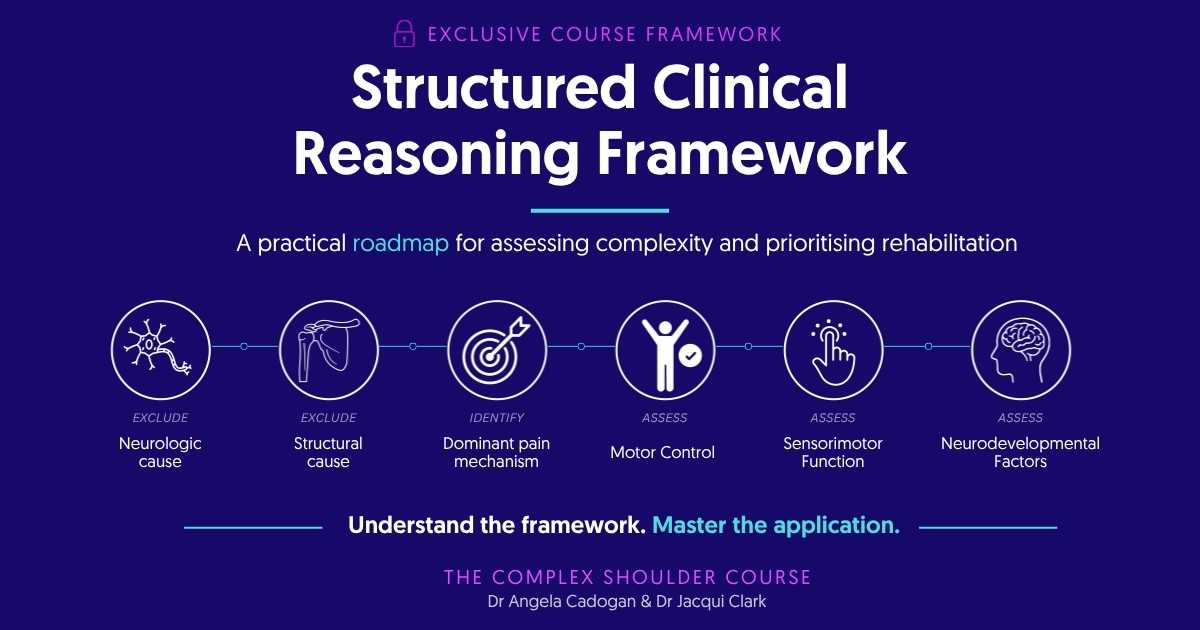
Apply a structured clinical reasoning framework to complex shoulder presentations.
Differentiate the predominant pain mechanisms contributing to shoulder pain and understand key management priorities.
Identify the key biological, neurological and psychosocial factors influencing rehabilitation and apply effective intervention.
Prioritise assessment findings to guide clinical decision-making.
Design targeted, evidence-informed rehabilitation programmes.
Adapt assessment and rehabilitation strategies for patients who are not progressing as expected.
Recognise when further investigation, referral or multidisciplinary management is indicated.
PART 1: Online Learning (Approx 2.5 hrs)
Build your theoretical foundation before attending the practical course so practical time can be devoted to hands-on assessment, clinical reasoning and case-based applications:
(Access for 1 year after the course.)
PART 2: Practical Course (1.5 days)
Apply the framework through hands-on assessment, rehabilitation, clinical reasoning exercises and case studies.
Presented by: Dr Angela Cadogan and Dr Jacqui Clark
Find out more about this blended learning course:

All Courses
Online Course (2 hrs). Learn how interacting biologic, neurologic and psychosocial factors contribute to complex shoulder presentations.

All Courses, Shoulder
1.5-Day Practical Course. Master the assessment and rehabilitation of complex shoulder presentations using a practical, contemporary clinical reasoning framework.



Angela is a NZ registered Physiotherapy Specialist (Musculoskeletal) with a Ph.D in Musculoskeletal Diagnostics from AUT University, Auckland, New Zealand (2012) (shoulder sub-specialty). Based in Christchurch, she works as a clinical consultant in her own private practice specialising in the diagnosis and management of shoulder pain.
Angela also works in an Orthopaedic Triage and Assessment role (Shoulder Service) with the Canterbury District Health Board. Angela has an ongoing research interest in shoulder conditions, has many publications on the topic, has been an invited keynote speaker at many national and international shoulder conferences and is Associate Editor at JOSPT (Journal of Orthopaedic and Sports Physical Therapy).
Angela has been teaching courses on the diagnosis, management and rehabilitation of shoulder conditions for over 10 years and is passionate about upskilling other physiotherapists and improving capability of the physiotherapy workforce to meet the needs of the changing healthcare system. Angela is the director of Physio Academy. Learn more: www.drangelacadogan.co.nz

Registered Specialist Pain Physiotherapist at ‘Pains and Brains’.
Jacqui holds a joint PhD from two European Universities and has lectured extensively around the world in motor control and sensorimotor retraining for recurrent and persistent musculoskeletal injuries. She is a registered Specialist Physiotherapist and works clinically in Tauranga at Pains and Brains.
Cancelation Terms & Conditions
Physio Academy may cancel a course due to insufficient registrations. In this instance a full refund will be given. We recommend you book refundable travel and accommodation or take out insurance cover.
Registrant Cancelations
Exceptions:
*We understand that sometimes the unavoidable happens and people can't attend a course due to illness, a family situation, or other last-minute reasons. In this case, we give you the option to find a suitable health professional to take your place on the course. Let us know their contact details (name, email, mobile number) so we can transfer your enrolment to them. And you sort out payment with them. The cancellation policy applies to your replacement as well.
We recommend you consider travel insurance for flights and accommodation in case of course disruptions or cancellations.

Access 12 months | All Unstable Shoulder lessons in one discounted package. | Clinical diagnosis of shoulder instability | Diagnosis of Shoulder Instability | Management of Shoulder Instability.
$100

Cost: $25 | Access: 12 months | Latest evidence relating to the pathomechanics, clinical and imaging diagnosis, referral criteria and rehabilitation of traumatic shoulder instability.
$25

Cost: $20 NZD | Access: 12 months | In this webinar Dr Ian Horsley presents considerations for return to playtesting for the shoulder when considering returning to sport. CDP Certificate and handouts included.
$20

RECORDED | Access: 12 months. In this webinar we look at the management of patients with complex shoulder conditions and how they are assessed and managed in a Specialist Shoulder Unit in the UK.
$20

Access: 12 months | Identifying the type of pain, mechanisms contributing to persistent pain and the influence of psychosocial factors are critical in the diagnostic process, and in selection of appropriate treatment interventions.
$50

Access:12 months | Pre-recorded | Cost $20 NZD. Identify common reasons why people with shoulder pain often don’t improve with physiotherapy treatment and will give you practical tips on what you can do to get them progressing in the right direction.
$20

Access: 12 months. We will cover the definition of pain, nociception and the protective mechanism normal resting state, nocifensive behaviour, the transition of acute to persistent pain as well as two take-home applications.
$60
