
Enhancing Muscular Performance
The 3-Component Model in Injury and Performance
A model-based framework for understanding contractile and elastic contributions to force generation and implications for muscle-tendon injury rehabilitation.
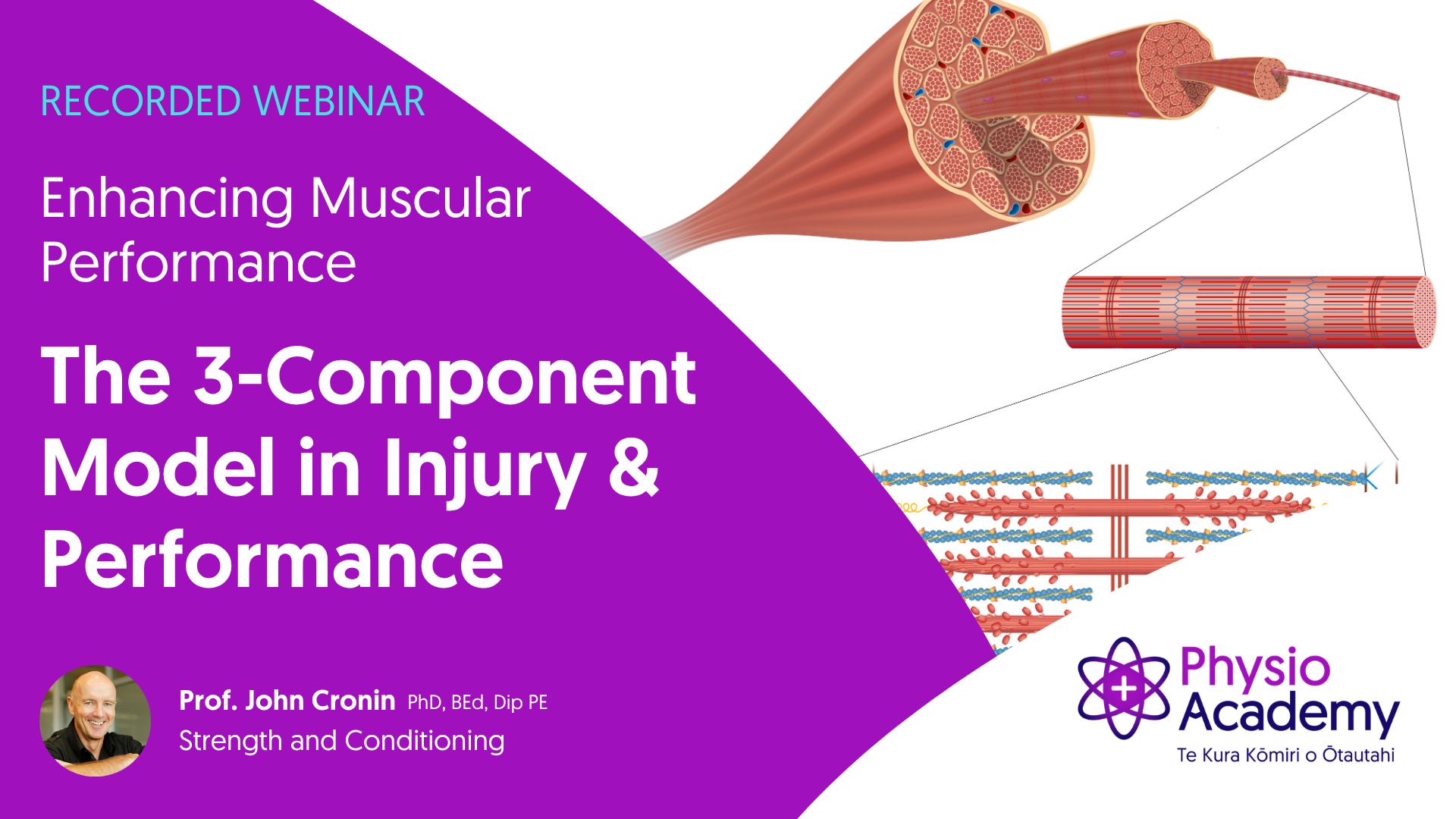
In this webinar Prof John Cronin gives an overview of the 3-component muscle–tendon model. There is so much more to rehab than just strength. Learn why you need to apply contractile and elastic principles to rehab and performance.
This webinar is for INDIVIDUAL use only. Group use not permitted. For corporate and commercial licenses and discounts, please contact Physio Academy.
Study time: 45 minutes
Recorded: 30 April 2026
Understanding muscular performance requires more than measuring strength.
Force production, movement efficiency and injury resilience are determined by the interaction between contractile and connective tissue elements within the muscle–tendon unit.
This session introduces a structured model that clarifies how these components contribute to performance and how they can be targeted in both rehabilitation and training to reduce injury recurrence and optimise performance.
CPD certificate provided
Access to the recording for 12 months
Live Online (Replay available)
All webinar attendees will receive:
Applies to:
• Enhancing Muscular Performance courses
• Webinars
• Research Bytes
Discount code will be provided after the webinar.


Professor, Strength and Conditioning, AUT University Head of Research, Lila Movement Technology
Hi I am John Cronin, AKA JC and I am a Professor in Strength and Conditioning. I am primarily an educator, researcher and mentor. I have two passions – one related to improving human movement, athleticism and sporting performance via strength and conditioning, and the other related to sharing this information with others.

Access: Lifetime of site | This course will teach you about the muscle-tendon properties that underpin force production and how to assess those properties to help you design rehabilitation programmes that target specific tissues.
$160

Access: Lifetime of site. This course is an in-depth look at the mechanical relationships, namely length-tension and force-velocity, that influence mechanotransduction and protein synthesis.
$150

Access: Lifetime of site |This course will introduce and extend your knowledge in muscle hypertrophy, architecture and fibre type.
$150

Access: Lifetime of site | Learn and apply the essentials of movement competency screening, assessment of landing mechanics and limb asymmetry assessment for rehabilitation to help minimise injury risk and optimise performance.
$150

Access: Lifetime of site | Learn to assess interlimb asymmetry using jump and hop tests including the use of force plate technology and diagnose specific muscle performance deficits to guide your rehabilitation.

FREE | Access: lifetime of site| This webinar is an introduction to force plates for physiotherapists with practical examples of force plate analysis of jump performance and clinical applications for rehabilitation in sports and community practice.
Free

In this short course, you will learn how flywheel resistance training differs from other forms of strength training. You will also learn where it can add real value into your strength and conditioning and rehabilitation programs.
Free

In this online course, John covers the basics and specifics of flywheel training, eccentric exercises and much more! The Flywheel Resistance Training Course contains a: Masterclass, Assessment Zone and Exercise Zone.
$150

This short course aims to help you make sense of balance, and the various types of assessment that can inform better diagnostics and programming.
$50

This free resource will provide a basic introduction into force and using force plates to assess and monitor athletes and patients.
Access: Lifetime of site | Learn to assess interlimb asymmetry using jump and hop tests including the use of force plate technology and diagnose specific muscle performance deficits to guide your rehabilitation.

Resisted sprint training, including sled pushes and pulls, builds movement-specific strength to enhance speed—especially acceleration. Learn how light to heavy loading can horizontally overload athletes, plus key research insights and programming tip

This short course aims to help you make sense of force plates, what they measure and how you can use them to inform and better your diagnostics and programming.

Why do power athletes cycle this type of training into their periodized plan? It might have something to do with the influence of this type of training on the quality and quantity of connective tissues that contribute to force production...

Access: 12 months | Join JC in a webinar unpacking the physiology and mechanics of eccentrics and stretch-shorten cycle, and their application to musculotendinous function, assessment and programming for different rehab and performance goals.
Free
FREE | Access: lifetime of site| This webinar is an introduction to force plates for physiotherapists with practical examples of force plate analysis of jump performance and clinical applications for rehabilitation in sports and community practice.
Free

This recorded webinar focuses on how to assess interlimb asymmetry using a range of different equipment and methods.
$80

The presentation outlines the shift in muscle force testing, reviews common strength assessments and contraction modes, and then focuses on force‑time concepts, emphasising impulse and rate of force development
Free
In this short course, you will learn how flywheel resistance training differs from other forms of strength training. You will also learn where it can add real value into your strength and conditioning and rehabilitation programs.
Free

Unlock the power of force plate technology in your physiotherapy practice! This guide, led by Professor John Cronin, covers key concepts, implementation tips, and diagnostic applications to enhance patient assessment and rehab strategies.
Free

Summarises research on backwards running, outlining how running in reverse affects movement mechanics, muscle activation, performance and injury‑related factors, with evidence‑based insights into its training and assessment applications.
Free

Summarises how cable pulling methods are used to develop horizontal eccentric braking and deceleration capability in athletes, outlining research‑based insights into force‑based training mechanics and performance implications.
Free

Summarises key insights on eccentrics, outlining how eccentric muscle actions affect force, strength adaptations and performance, with evidence‑based considerations for strength and conditioning training.
Free

Summarises evidence on eccentric exercise for hamstring injury, outlining how eccentric training influences hamstring injury prevention and rehabilitation with research‑based insights for conditioning and recovery.
Free

Explore how the parallel elastic component (PEC) contributes to force transmission. Learn the role of mysial tissues & titin in lateral force transfer, specific tension, and how targeted training can enhance connective tissue strength and performance
Free

